


A stool test kit captures a small specimen from a bowel movement and produces a measurable result about what is happening inside your digestive tract. That single definition covers a wide range of products, and the differences between them matter more than the marketing suggests. Two kits can both be labeled a gut health test, arrive in similar packaging, and take the same three minutes of your morning! While measuring entirely different things and answering entirely different questions.
If you are trying to decide whether one is worth buying, the useful starting point is not price or turnaround time. It is understanding which category of test you are actually holding.
What a stool test kit is, and the three categories people confuse
Almost every product on the market falls into one of three groups. The three categories are not competitors. A screening kit will not tell you whether your fiber intake is working, and a composition report will not screen you for cancer. Confusion between them is the most common reason people feel disappointed by a result.
Disease screening kits. These detect markers associated with specific conditions, most commonly colorectal cancer. The fecal immunochemical test looks for human hemoglobin in stool. Multitarget stool DNA tests like Cologuard combine molecular assays for mutations and methylation markers with a hemoglobin immunoassay. Multitarget stool RNA tests like ColoSense measure RNA transcripts alongside a fecal immunochemical test. All are regulated diagnostics with defined sensitivity and specificity, typically ordered through a clinician, with a single purpose: determine whether a colonoscopy is needed. For a deeper comparison of stool-based colorectal cancer screening, see our separate piece on that topic.
Composition sequencing kits. These are what most people picture when they hear gut microbiome test. A stool sample is shipped to a lab, where 16S rRNA or shotgun metagenomic sequencing produces an inventory of which bacterial species are present and in what relative proportion. Output is usually a diversity score alongside a taxonomic report.
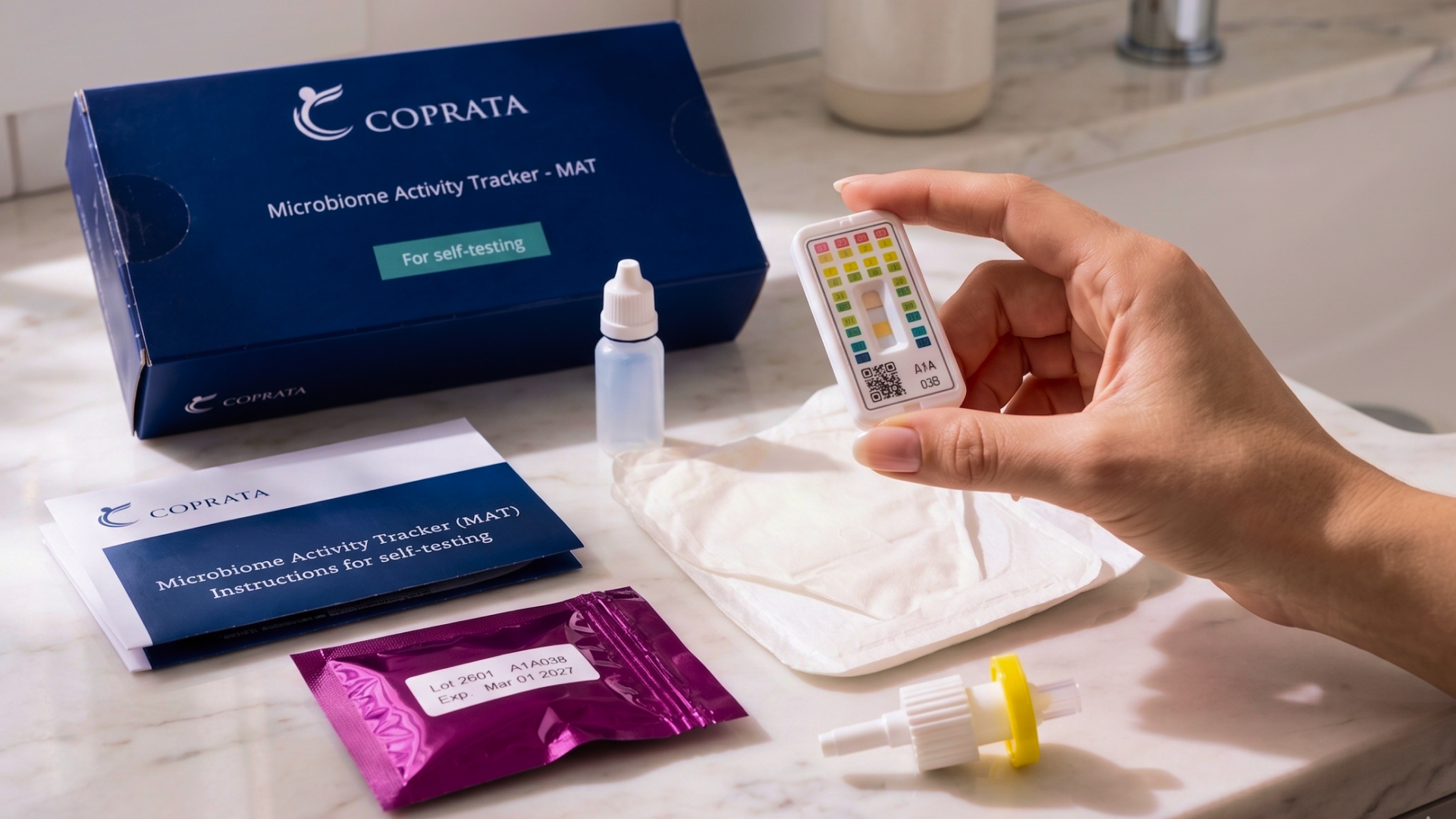
Functional activity kits. These measure the chemical output of the microbial community rather than its membership or measure substances released by human cells in the gut. Markers include fecal pH, fecal calprotectin, and indicators tied to digestion. Coprata's Microbiome Activity Tracker falls into this category, reporting a single chemical measurement as a score from 1 to 10.
Composition versus activity, and why that distinction is the whole ballgame
Sequencing answers the question "who is in there." Functional testing answers the question "what are they doing." Those are not the same question, and the gap between them is where most of the interpretive difficulty lives.
A species list is a census. It tells you which organisms were present in a specimen at a given moment. It does not tell you whether those organisms were actively fermenting, which metabolites they were producing, or in what quantities. Two people can carry broadly similar taxonomic profiles while their microbial communities behave very differently. This is not a theoretical concern. The Integrative Human Microbiome Project followed 132 subjects for a year, generating nearly 3,000 stool, biopsy, and blood specimens to build integrated molecular profiles of host and microbial activity. Disease activity appeared as functional disruption. Shifts in microbial transcription and measurable changes in metabolite pools, including short-chain fatty acids and bile acids. These were changes a taxonomy list alone would not have captured.
Composition testing also has a more practical limitation. Research has not established a reference range for a normal or optimal microbiome the way it has for cholesterol or blood glucose. A report placing a particular genus at the 30th percentile is describing you relative to a comparison group, not a validated clinical standard. Activity markers are more tractable because they measure a chemical value that can be tracked against itself over time.
What the collection process involves, and why sample handling changes the result
Every stool test kit follows the same basic process: collect a small specimen using a provided scoop or collection sheet, then mail it to a lab or process it at home. The mailing step is where significant variability enters. Stool remains metabolically active after it leaves the body. Microbes continue fermenting, and the sample's chemistry keeps shifting. Research has found that bacterial taxa measurements varied after as little as 15 minutes at room temperature, with recommendations to freeze within that window and limit home freezer storage to under three days. Separate work on room-temperature shipping found that certain organisms proliferate so predictably in transit that researchers developed a computational filter to remove them before analysis.
For a consumer purchasing a kit, the implication is straightforward. If your specimen spends two days in a delivery vehicle, part of what the lab measures is the journey itself. Preservative buffers help, and reputable labs account for this, but the effect is real and hits some markers harder than others. Volatile measures are the most vulnerable. Fecal pH being a clear example of a value that is genuinely difficult to capture outside a controlled lab setting. There is also an adherence problem that rarely appears in product copy. Research has repeatedly identified reluctance to handle a specimen as a major barrier to compliance, which is why simplified collection systems have become an active area of product development. A kit that is unpleasant to use will not become a tracking habit, and a single data point is worth far less than a consistent series.
How to evaluate a kit before buying
Six questions separate a kit that tells you something from one that simply tells you a lot.
1- What, specifically, is measured? Look for named markers. Vague language about gut health without a stated measurand is a signal to keep reading.
2- Is it composition or activity? Decide which question you want answered before you buy, then match the product to it.
3- How long until results, and where does analysis happen? Home-processed results avoid transit variability. Lab-processed results allow more complex analysis. Both are legitimate, and the tradeoff should be stated explicitly.
4- What is the retest cadence, and what does a retest cost? Evaluating any change requires at least two measurements. A kit that is affordable once but not four times cannot show you a trend.
5- Is there published research behind it? Look for peer-reviewed work on the specific measurement not general microbiome literature cited to imply validation of a particular product.
6- What is the regulatory status, and what claims are attached? Diagnostic screening tests and wellness tracking tools are different things, and that distinction should be stated plainly.
What to do with a result, and when to retest
A single result is a starting position, not a verdict. The real value comes from the second, third, and fourth measurement! That is where a trend becomes visible. Establish a baseline before changing anything. Then change one variable (fiber intake, a supplement, sleep, or exercise) and hold it steady long enough for an effect to appear. Retest and compare against your own baseline, not a population average. For the MAT, testing every one to two weeks works well when evaluating a change. Monthly testing is appropriate once you have found a routine to maintain. Measurable shifts can appear within about two weeks, keeping the feedback loop meaningful.
If your result raises a concern, or if you have symptoms such as bleeding, unexplained weight loss, or a persistent change in bowel habits, speak with a clinician rather than running a self-directed experiment. Screening decisions should be made with a physician.
If you want a gut health test you can run at home and repeat often enough to see whether your changes are working, see how the Microbiome Activity Tracker works.
The Coprata Microbiome Activity Tracker kit, its related services, and this website are intended for informational and educational purposes only. They are not medical devices and are not designed to diagnose, treat, cure, or prevent any disease or health condition.
References
Imperiale, T. F., Ransohoff, D. F., Itzkowitz, S. H., et al. (2014). Multitarget stool DNA testing for colorectal-cancer screening. New England Journal of Medicine, 370(14), 1287-1297.
Barnell, E. K., Wurtzler, E. M., La Rocca, J., et al. (2023). Multitarget stool RNA test for colorectal cancer screening. JAMA, 330(18), 1760-1768.
Lloyd-Price, J., Arze, C., Ananthakrishnan, A. N., et al. (2019). Multi-omics of the gut microbial ecosystem in inflammatory bowel diseases. Nature, 569, 655-662.
Gorzelak, M. A., Gill, S. K., Tasnim, N., et al. (2015). Methods for improving human gut microbiome data by reducing variability through sample processing and storage of stool. PLOS ONE, 10(8), e0134802.
Amir, A., McDonald, D., Navas-Molina, J. A., et al. (2017). Correcting for microbial blooms in fecal samples during room-temperature shipping. mSystems, 2(2), e00199-16.
Grego, S., Welling, C. M., Miller, G. H., et al. (2022). A hands-free stool sampling system for monitoring intestinal health and disease. Scientific Reports, 12, 10859.