

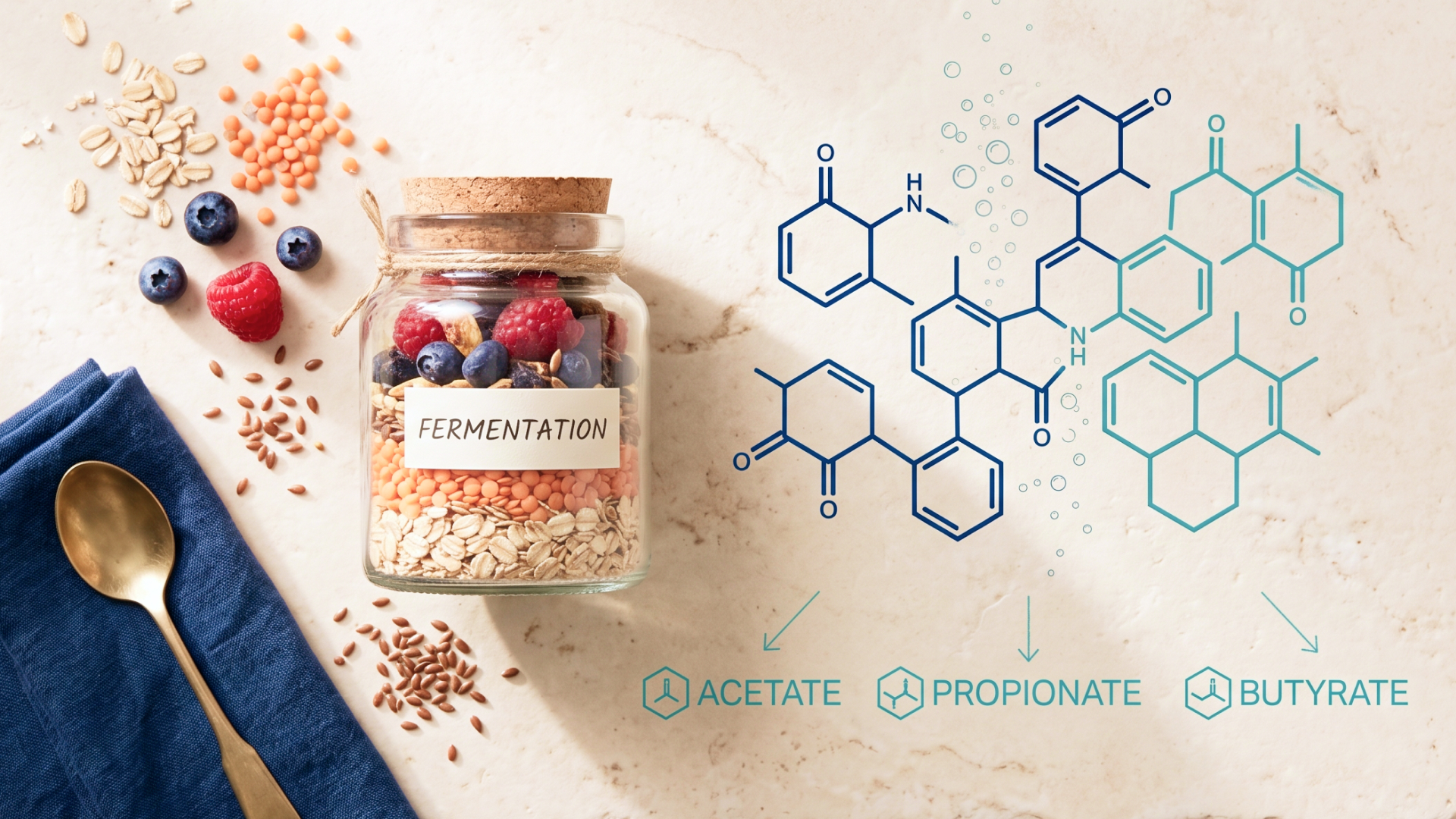
It is one of the most profound evolutionary bargains in human history: we simply stopped evolving the ability to digest certain foods. Instead of building our own biological machinery to process complex plants, we outsourced the job to trillions of microbial roommates.
We provide the housing and the raw materials (the tough fibers we cannot digest), and in exchange, these microbes ferment that indigestible material into a high-value biological currency called Short-Chain Fatty Acids, or SCFAs. While we do not produce these essential compounds ourselves, we have evolved to be entirely dependent on them. It is a bit like living in a house where you do not know how to cook, but you have world-class chefs living in the basement who only ask for your kitchen scraps as payment.
The irony? These life-saving compounds are the very same ones that give vinegar its sting, Swiss cheese its tang, and rancid butter its distinctive aroma.
The Trio: Molecules That Smell Bad but Do Good
The "big three" SCFAs (acetate, propionate, and butyrate) are the main metabolites produced by your microbiome. While they might be considered unpleasant in the outside world, inside your body, they are essential.
It is a hilarious biological irony that the wellness trend of the decade focuses on turning your colon into a miniature, high-production vinegar and cheese factory. We spend a fortune on deodorants and scented candles to escape these smells, yet our health largely depends on our ability to brew them internally.
The Total Body Benefits: From Gut to Brain
The reach of SCFAs extends far beyond the walls of your intestines. Once produced, they act as sophisticated signaling molecules that communicate with almost every organ system.
The Gut Shield: Butyrate is the primary fuel for the cells lining your colon (colonocytes). It keeps the gut barrier tight, preventing systemic inflammation and ensuring your intestinal walls do not leak toxins into your bloodstream. Without adequate butyrate, the gut barrier becomes permeable, a condition often referred to as "leaky gut."
Metabolic Management: Propionate travels to the liver to help regulate glucose production. SCFAs also trigger the release of hormones like GLP-1 (the same pathway targeted by weight-loss drugs like Ozempic), which naturally suppress appetite and signal fullness to the brain. When propionate and acetate are produced in high quantities, they stimulate hormones like PYY and GLP-1, effectively overriding your hunger hormones at a physiological level.
Brain Protection: SCFAs can cross the blood-brain barrier, one of the body's most selective entry points. Once there, they help maintain the tight junctions of this barrier, literally acting as a sealant to prevent neuroinflammation. Low levels of SCFAs have been linked to brain fog, anxiety, and even the progression of Alzheimer's disease. Butyrate also promotes better sleep by acting on circadian clock gene expression and lowering inflammation.
Immune Tuning: SCFAs act as peacekeepers for the immune system, helping it distinguish between actual threats and harmless food. This reduces the risk of allergies and autoimmune responses.
How to Fuel Your Internal Factory
You cannot just eat SCFAs directly (unless you want to drink straight vinegar and consume rancid butter, which we do not recommend). You have to create the environment for them to be produced.
Eat a Lot of Fiber: Fiber is the raw substrate for fermentation. Think of it as the coal for the engine. Focus on legumes, lentils, oats, and even cooked-and-cooled starches like potatoes or rice, which develop resistant starch (the favorite meal of butyrate-producing bacteria). [text link to Coprata's fiber content goes here]
Soluble fiber from oats, apples, and chia seeds provides the perfect substrate for acetate and propionate production. Resistant starch from cold potatoes, green bananas, and legumes is elite fuel for butyrate-producing bacteria.
Exercise Regularly: Moving your body actually shifts the composition of your microbiome. Research shows that cardiovascular exercise independently increases the concentration of SCFA-producing bacteria, regardless of what you eat. You do not need to run a marathon; regular, moderate aerobic exercise is enough to keep production running efficiently. Exercise increases blood flow to the gut and may alter the oxygen gradient in the intestinal walls, favoring the anaerobic bacteria that specialize in fermentation.
Track What Matters: Because SCFAs are such critical indicators of gut health, measuring them can provide insight into whether your fiber intake and lifestyle habits are actually working. [Coprata's MAT kit]
The Evolutionary Partnership
We are what biologists call a "holobiont," a collection of species working together. By feeding your fiber-loving bacteria and staying active, you are not just staying healthy; you are honoring a million-year-old evolutionary contract.
Our bodies evolved to outsource these critical functions entirely. We do not produce SCFAs ourselves; we rely on microbial roommates to make them for us. It is a perfect partnership: we provide the indigestible fiber, and they turn it into the compounds that keep our brains sharp, our appetites in check, and our gut barriers sealed.
The next time you catch a whiff of sharp vinegar or a pungent block of Parmesan, give a little nod of thanks to your gut. Your health depends on keeping things just a little bit pungent on the inside.
Reference
Morrison, D., & Preston, T. (2016). Formation of short chain fatty acids by the gut microbiota and their impact on human metabolism. Gut Microbes, 7, 189 - 200. https://doi.org/10.1080/19490976.2015.1134082
Koh, A., Vadder, F., Kovatcheva-Datchary, P., & Bäckhed, F. (2016). From Dietary Fiber to Host Physiology: Short-Chain Fatty Acids as Key Bacterial Metabolites. Cell, 165, 1332-1345. https://doi.org/10.1016/j.cell.2016.05.041
Silva, Y., Bernardi, A., & Frozza, R. (2020). The Role of Short-Chain Fatty Acids From Gut Microbiota in Gut-Brain Communication. Frontiers in Endocrinology, 11. https://doi.org/10.3389/fendo.2020.00025