
This week, we walked through the supplement aisle of any health food store and you will find no shortage of fiber products making bold claims. Psyllium husk capsules promising regularity. Inulin powders marketed as prebiotic support. Gummies, powders, and chewables are positioned as the easiest way to hit your daily fiber goal.
For the roughly 95% of Americans who consistently fall short of recommended fiber intake, these products can seem like a practical fix. In some situations, they genuinely are useful. But understanding what fiber supplements can and cannot do, and how they compare to the best fiber foods available, is essential before making them a regular part of your routine.
Why People Turn to Fiber Supplements
The gap between how much fiber most people eat and how much their bodies actually need is significant. Current recommendations sit at around 25 grams per day for adult women and 38 grams for adult men. Recent research suggests that intakes above 40 grams per day may offer even greater protection against cardiovascular disease, type 2 diabetes, and certain cancers. For someone eating a typical Western diet heavy in refined grains and processed foods, getting anywhere close to those numbers through food alone requires a meaningful shift in eating habits.
Fiber supplements offer a convenient bridge. They are easy to dose, require no meal planning, and can be added to water, smoothies, or taken in capsule form with minimal effort. They have a legitimate role for people recovering from certain digestive conditions, managing specific symptoms, or simply working to close a gap while building better food habits. The problem arises when they are treated as a substitute for dietary fiber rather than a supplement to it, hence the name.
The Most Common Types of Fiber Supplements
Not all fiber supplements are formulated the same way, and the type of fiber they contain determines what they actually do in the body. Understanding the distinction between soluble and insoluble fiber matters here just as much as it does when evaluating food sources.
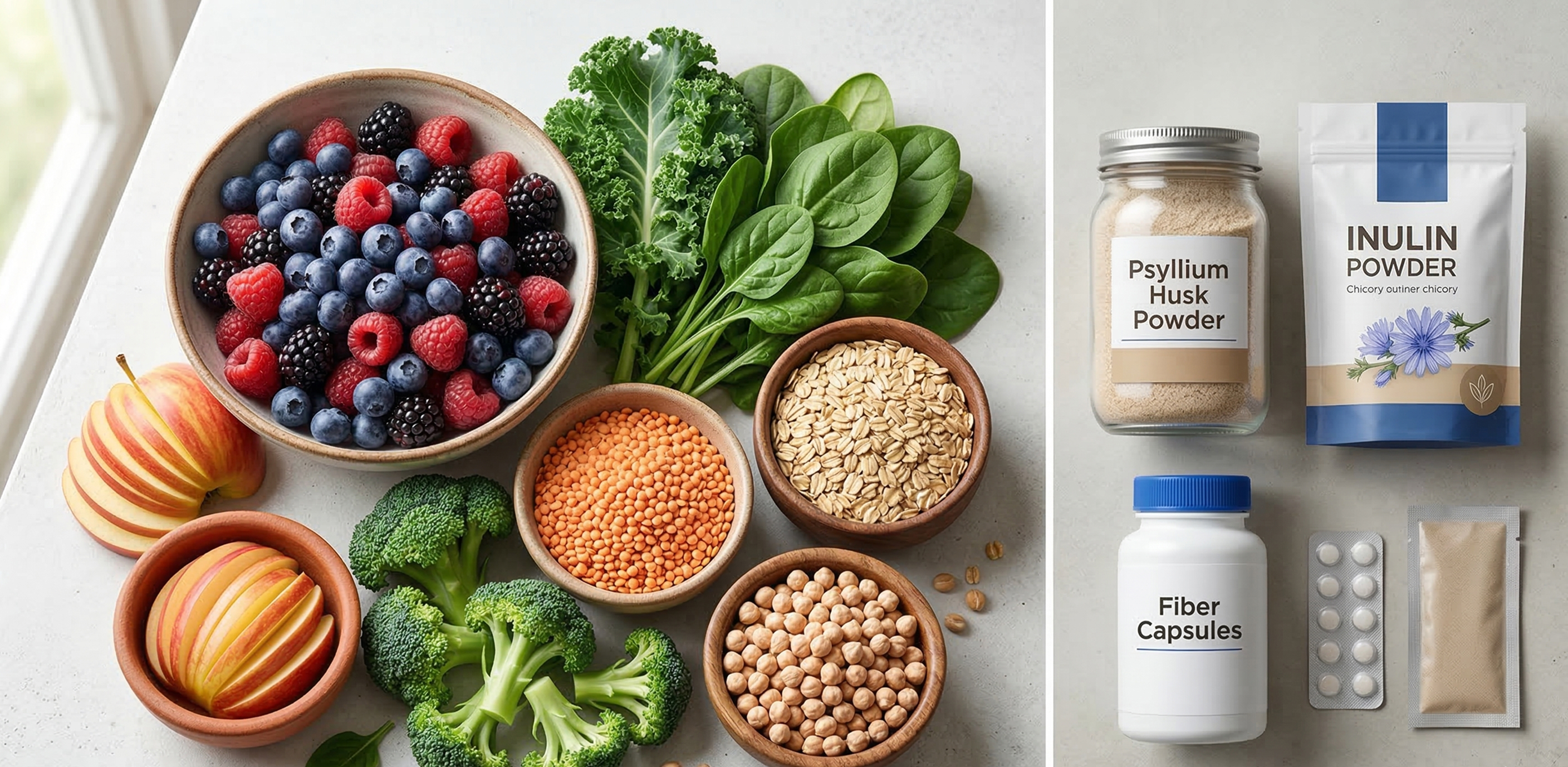
- Psyllium husk is one of the most well-researched fiber supplements available. It is predominantly soluble fiber, forming a gel in the digestive tract that slows digestion, helps regulate blood sugar, and has a clinically established effect on lowering LDL cholesterol. It also adds bulk to stool and supports bowel regularity, making it one of the more versatile options for general digestive support. Psyllium is the active ingredient in products like Metamucil and is frequently used in clinical settings for managing both constipation and diarrhea.
- Inulin is a soluble, prebiotic fiber derived from chicory root or agave. It ferments in the colon and selectively feeds beneficial gut bacteria, which is why it appears in many products positioned around gut health and microbiome support. It is also one of the most common isolated fibers added to processed foods and prebiotic sodas. The same properties that make it useful in controlled doses can cause significant bloating, gas, and digestive discomfort when consumed in excess, which is easy to do when it is hidden in packaged products.
- Partially hydrolyzed guar gum is a soluble fiber that has been processed to make it easier to digest and less likely to cause the fermentation-related side effects that inulin sometimes triggers. It dissolves completely in water without thickening, which makes it more tolerable for people who are sensitive to other fiber types. It is frequently used in clinical nutrition settings and has a reasonable evidence base for supporting bowel regularity and feeding beneficial gut bacteria.
- Methylcellulose and wheat dextrin are synthetic or processed soluble fibers used in products like Citrucel. They are less fermentable than inulin, which reduces the likelihood of gas and bloating, but they also offer less prebiotic benefit as a result.
What Supplements Cannot Replicate: The Food Matrix
The most important limitation of any fiber supplement is that it delivers fiber in isolation. This distinction matters enormously. The health outcomes that decades of research associate with high-fiber diets, such as reduced risk of colorectal cancer, cardiovascular disease, type 2 diabetes, and cognitive decline, are built on studies of whole food consumption, not supplemental fiber intake.
The reason is what researchers refer to as the food matrix. When fiber exists inside a whole plant food, it is surrounded by a complex structure of water, starches, polyphenols, vitamins, minerals, and other bioactive compounds that all interact during digestion. It is this complete matrix, not the isolated fiber molecule, that produces the full range of health outcomes the research documents.
A psyllium husk supplement delivers soluble fiber efficiently, but it does not deliver the phytonutrients in an apple, the resistant starch and protein in a lentil, or the polyphenols in a handful of walnuts. These are not minor additions; they are central to how fiber-rich foods support long-term health. This does not make supplements useless. It means they are most valuable as a targeted tool for specific needs, not as a daily replacement for the best fiber foods available.
Prebiotic Fiber: Supplements vs. Food Sources
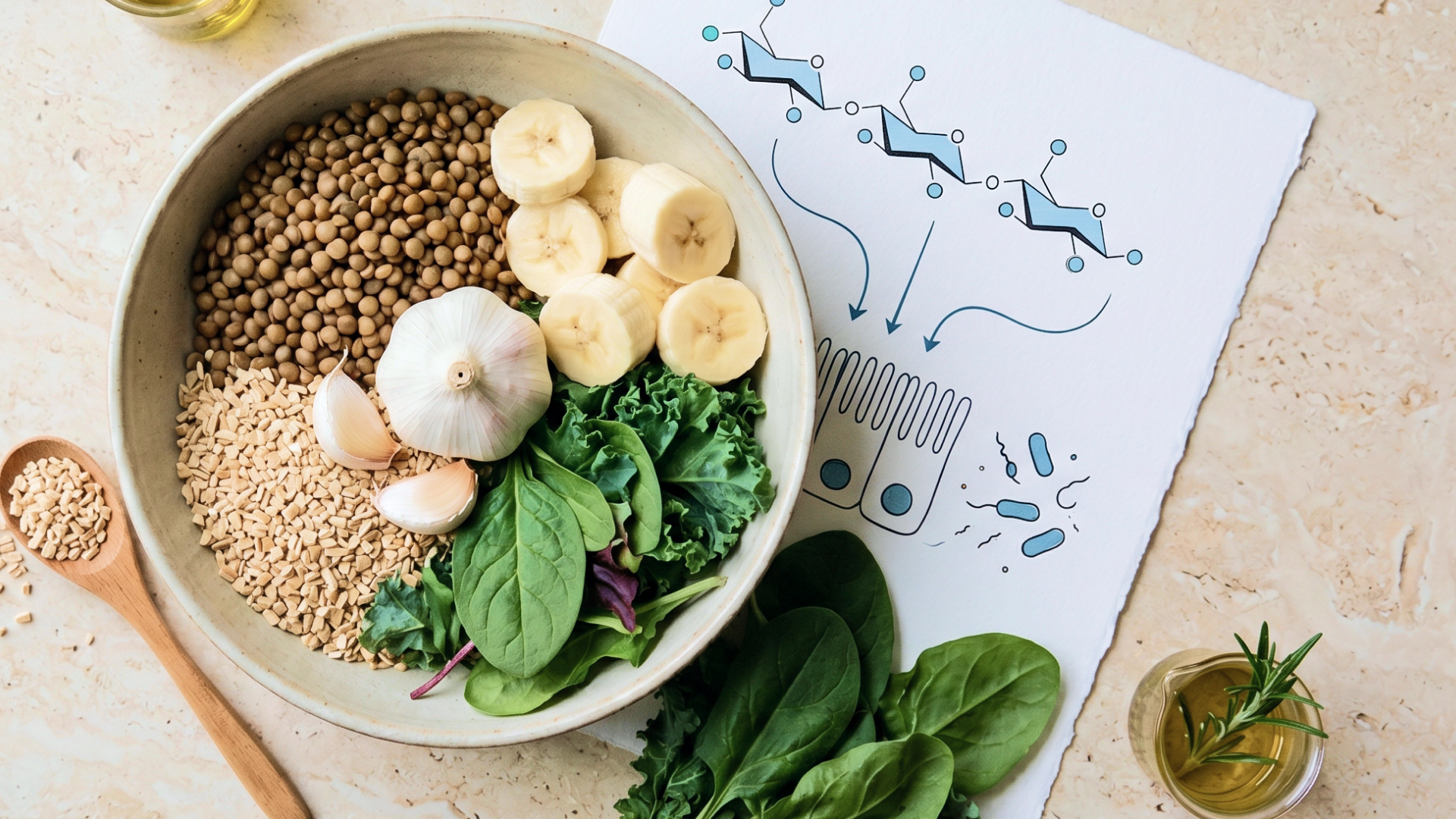
The category of prebiotic fiber deserves specific attention because it is one of the most actively marketed claims in the supplement space right now. Prebiotic fiber refers to fiber compounds that selectively feed beneficial gut bacteria, stimulating their growth and activity in ways that benefit the host. The short-chain fatty acids those bacteria produce, particularly butyrate, nourish the gut lining, support immune regulation, and are linked to reduced systemic inflammation.
Inulin and fructooligosaccharides (FOS) are the most common prebiotic fibers found in supplements, and they do have a real effect on gut bacterial populations. The issue is that they feed a relatively narrow range of bacterial species. A diverse, thriving gut microbiome requires a much broader spectrum of fiber types than any single supplement provides.
Whole food sources of prebiotic fiber, such as garlic, onions, leeks, asparagus, bananas, oats, legumes, and chicory root itself, deliver prebiotic compounds alongside dozens of other bioactive nutrients and fiber structures that collectively support a far wider range of microbial populations. For long-term microbiome diversity, food sources are not just preferable; they are functionally superior in ways a supplement cannot replicate.
How Supplements and Whole Foods Work Together
The most effective approach to fiber intake treats supplements as support for a whole-food diet, not a replacement for one. A psyllium supplement taken daily while also eating a varied, plant-rich diet provides more total benefit than either approach alone for someone who genuinely struggles to meet their fiber needs through food. The supplement closes the gap on quantity while the food provides the diversity and the matrix that drive long-term outcomes.
Where this breaks down is when supplements become an excuse to avoid changing dietary habits. Someone eating a low-fiber diet and adding a fiber gummy is not achieving the same result as someone eating beans, vegetables, whole grains, and fruit regularly. The numbers on paper might look similar. The impact on the gut microbiome will not be.
Practical Guidance for Using Fiber Supplements Safely
Anyone adding a fiber supplement to their routine for the first time should introduce it gradually rather than starting at a full dose. The gut microbiome needs time to adjust to increased fiber intake, and jumping in too quickly is the most common cause of bloating, gas, and digestive discomfort. Starting with half the recommended dose and increasing over two to three weeks gives the microbial community time to build up the bacterial populations needed to ferment the additional fiber without producing excessive gas.
Hydration is equally important. Both soluble and insoluble fiber require adequate water to function properly. Soluble fiber forms its gel-like structure in water, and insoluble fiber relies on fluid to help bulk move efficiently through the colon. Taking a fiber supplement without drinking enough water can actually contribute to constipation rather than relieving it.
Mixing fiber types matters here just as it does with food. Rather than relying exclusively on one supplement type, rotating between options, or combining a supplement with a varied whole-food diet, ensures a broader range of bacterial populations receive adequate fuel. The target of 30 different plant foods per week applies regardless of whether supplements are part of the picture. Supplements can contribute to closing the gap on total fiber intake, but they do not count toward that variety target in any meaningful way.
How to Know Whether Your Fiber Strategy Is Working
One of the genuine challenges with fiber and gut health is that the effects are not always immediately visible or felt. Two people following identical high-fiber diets can have substantially different microbiome outcomes depending on their baseline bacterial populations, digestive transit time, and individual response to specific fiber types. What registers as "enough" based on how you feel may not be producing meaningful change at the microbial level.
This is where tracking changes in gut microbiome activity over time provides information that subjective experience cannot. Rather than guessing whether a fiber strategy is working, measuring how the microbiome responds as dietary inputs change gives objective data to guide adjustments. The Microbiome Activity Tracker is designed to support exactly this kind of longitudinal tracking, making it possible to see how the gut responds to changes in fiber intake, supplement use, or dietary variety in real time, and to adjust accordingly.
The best fiber supplement is the one that supports a whole-food diet rather than replacing it. Psyllium husk, inulin, partially hydrolyzed guar gum, and other well-studied options each have legitimate uses and can help close genuine gaps in fiber intake. But no supplement delivers the full benefit of fiber from whole plant foods, and none can replicate the diversity of fiber types that a varied diet provides to the gut microbiome.
Use supplements as the name suggests: as supplemental support. Build the habit of rotating a wide range of legumes, vegetables, whole grains, fruits, nuts, seeds, and herbs into daily eating. That combination is where the real results come from.