
Your Smartphone Is Already a Medical Reader: Here's What That Means for At-Home Health
For most of their history, the final step for rapid diagnostic tests has been the same: a person looks at a strip, reads a line, and makes a judgment call. A faint line could mean a positive result, but this interpretation is left to inconsistent human eyes.
That is beginning to change.
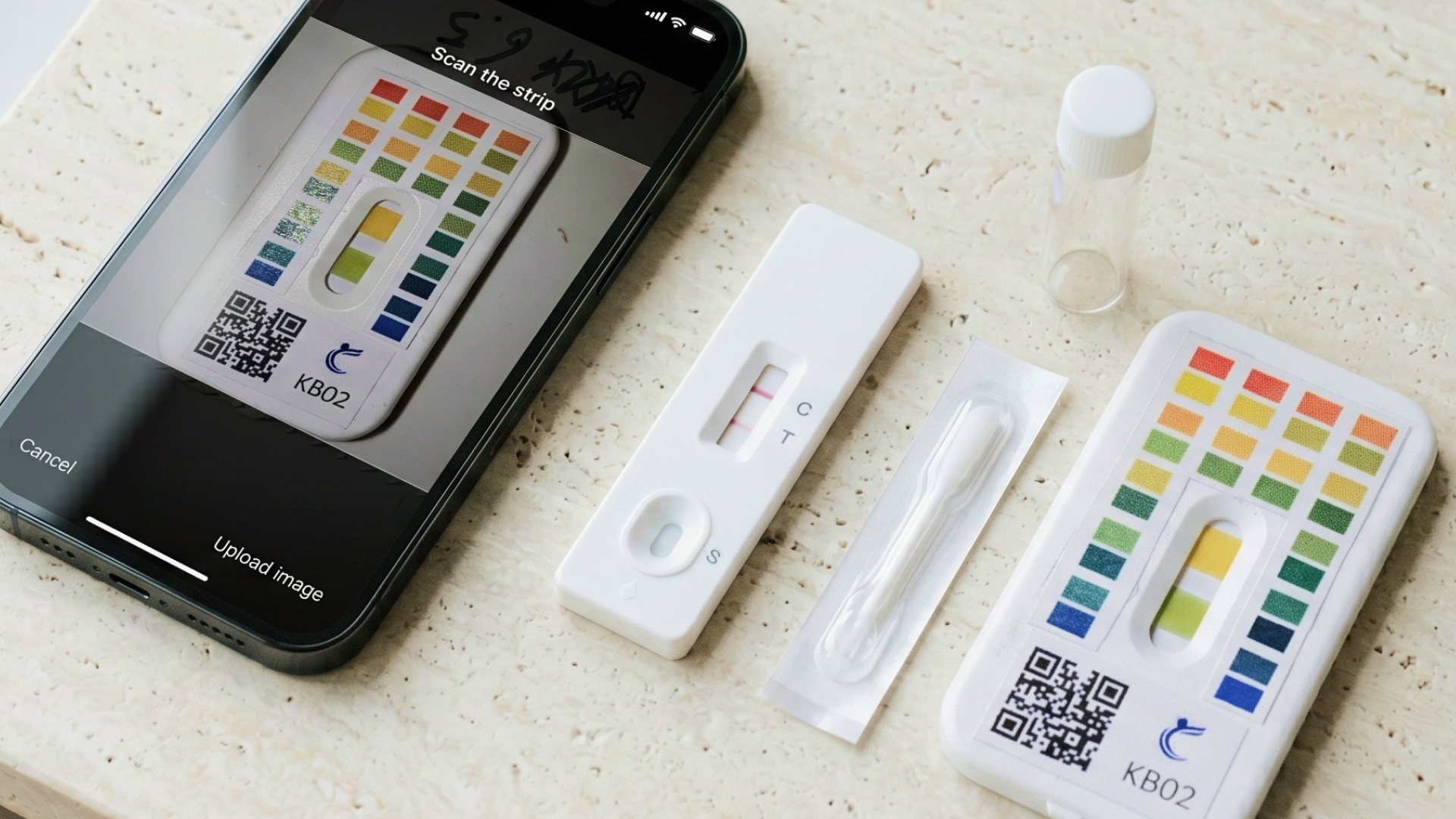
Rapid tests are now being paired with smartphone apps that use the phone's camera to analyze the result quantitatively. Instead of a person squinting at a strip, the smartphone acts as an optical reader, capturing the result and returning a precise measurement. The human eye is removed from the equation.
A recent study in Clinical Gastroenterology and Hepatology puts concrete numbers behind what this shift can accomplish.
What the Research Shows
Researchers have evaluated a smartphone-based fecal immunochemical test (FIT) for colorectal cancer screening. FITs detect traces of blood in stool, which can indicate polyps or colorectal cancer. While widely used in screening programs, these tests have traditionally required laboratory instruments for quantitative results.
The new system combines a standard rapid test strip with a smartphone app that analyzes the result using the phone's camera. In a study of 654 people, the smartphone-based FIT showed sensitivity and specificity comparable to conventional lab-based FITs. The study concluded this approach could serve as a viable alternative to currently offered laboratory tests.
This finding is significant. It demonstrates that a smartphone, paired with the right test and software, can produce clinically meaningful results that rival those from laboratory instruments. Not just in a small pilot study, but across a real-world population of over 600 individuals.
Why This Matters Beyond One Test
While colorectal cancer screening is important, the underlying technology trend is even more significant.
Historically, bridging the gap between a rapid test and a quantitative result required expensive laboratory instruments operated by trained technicians in centralized facilities. This made them inaccessible for at-home health management.
Modern smartphones are closing this gap. Their cameras have evolved into sophisticated imaging sensors with advanced computational photography and processing power that rivals older lab systems. When paired with purpose-built software, a smartphone can now act as a reader, turning a rapid test into a digitally interpreted, quantitative health measurement.
The implications extend far beyond colorectal cancer, with smartphone-assisted diagnostics emerging for infectious diseases, women's health, cardiovascular monitoring, and gut health. The common thread is that tests once requiring centralized infrastructure are moving closer to the individual, providing accuracy that is increasingly comparable to laboratory results.
Tracking Gut Health the Same Way
This principle also applies to the Microbiome Activity Tracker (MAT). The MAT merges a rapid biochemical test with smartphone-based interpretation, enabling users to monitor gut microbiome activity from home. This eliminates the need to ship a sample to a lab and wait for results. Instead, the smartphone reads the test, and the user receives immediate data.
The FIT study serves as a strong reference for this model's potential on a large, rigorous scale. When researchers evaluated if a smartphone could equal laboratory performance on a clinically validated test, the study confirmed that it could.
What This Trend Points Toward
At-home medical tests have long been seen as a trade-off: more convenient, but less reliable. This perception is changing. With improvements in smartphone hardware, computational imaging, and a growing body of peer-reviewed research, the performance gap between at-home and lab tests is shrinking.
The future of diagnostics won't always involve sending samples to a centralized lab and waiting for results. Increasingly, the precision once exclusive to a laboratory is becoming available to individuals when and where they need it most.
Reference
Hoffmeister M, Seum T, Ludwig L, Brenner H. Performance of a smartphone-based stool test for use in colorectal cancer screening: Population-based study. Clinical Gastroenterology and Hepatology. 2026;24(1):241–249.e3. PMID: 40403947